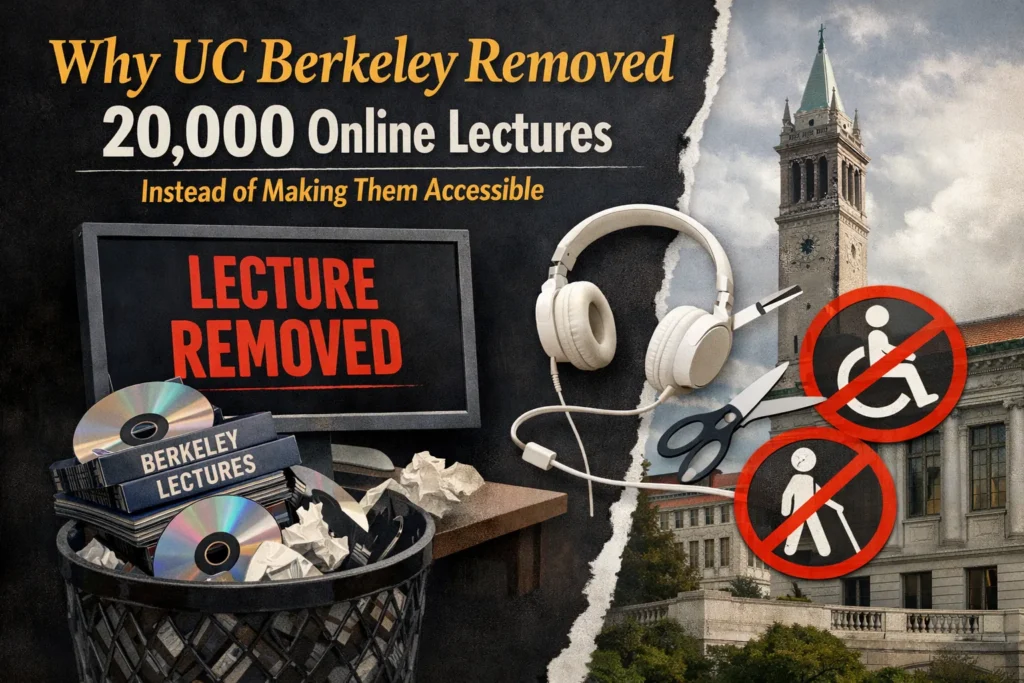
Why UC Berkeley Removed 20,000 Online Lectures Instead of Making Them Accessible
UC Berkeley made 20,000 lectures private to avoid captioning costs. The 2022 consent decree cost far more. Here is what it means for your video content.
What is the UC Berkeley accessibility consent decree? The UC Berkeley accessibility case began in 2014 when the National Association of the Deaf filed a formal complaint with the U.S. Department of Justice, alleging that thousands of UC Berkeley’s freely available online lectures lacked accurate captions. The DOJ investigated, found UC Berkeley in violation of Title II of the ADA in 2016, and ultimately filed a formal lawsuit. In November 2022 – eight years after the original complaint – UC Berkeley entered a consent decree requiring independent auditing, a dedicated accessibility coordinator, staff training, and phased WCAG 2.0 AA remediation across all platforms.
Video: Why UC Berkeley Removed 20,000 Online Lectures Instead of Making Them Accessible
The UC Berkeley story is usually told wrong. Most accounts say the university “deleted” 20,000 lectures. It didn’t. That distinction matters, because the decision that looked like a cost-saving workaround in 2017 became, five years later, a consent decree with obligations far heavier than the original captioning bill would have been.
The same avoidance calculation plays out every day on private business websites. The law is different (Title III rather than Title II) but the compounding logic is identical.
What Actually Happened – and What Most People Get Wrong
UC Berkeley did not delete the videos. Starting in March 2017, the university changed approximately 20,000 audio and video files from publicly accessible to private, requiring a UC login to view them. Public users were directed to Berkeley’s accessible courses on edX instead.
That distinction matters for two reasons. First, the content still existed – the access decision was deliberate and reversible. Second, Berkeley’s leadership made a calculated trade-off: restrict access rather than bear the captioning cost. That trade-off is what the DOJ continued to pursue.
The full arc spans 2014 to 2022. A complaint triggered an investigation. An investigation produced a finding. A finding prompted a workaround. The workaround didn’t end the case. A lawsuit followed. A consent decree closed it – with obligations that dwarfed the original remediation work. That sequence is the point of this article.
The 2014 Complaint That Started an Eight-Year Chain of Events
In 2014, the National Association of the Deaf filed a complaint with the DOJ alleging that UC Berkeley’s free public library of online courses, lectures, and conference recordings was inaccessible to people who are deaf or hard of hearing. The content was publicly available on YouTube and Berkeley’s own platforms – which is precisely why it triggered ADA obligations.
Title II of the ADA applies to public entities: state and local governments, public universities, public transit systems. Because UC Berkeley is a public institution making content broadly available, the complaint had standing. The NAD argued that the absence of accurate captions denied deaf and hard-of-hearing users equal access – not just to supplementary material, but to the same educational content Berkeley was offering everyone else for free.
What the DOJ Investigation Found in 2016
In August 2016, the DOJ formally concluded that UC Berkeley had violated Title II of the ADA. The finding identified more than 20,000 videos that either had no captions at all or relied on auto-generated captions with accuracy problems severe enough to render them effectively useless.
This is where WCAG Success Criterion 1.2.2 becomes relevant. The requirement, in plain terms: prerecorded video content that includes audio must have synchronized, accurate captions – not auto-generated text that regularly misfires on technical terms, proper nouns, or fast speech. The DOJ’s finding confirmed that YouTube’s automatic captioning did not satisfy this standard. Berkeley’s captions weren’t just imperfect – they were legally insufficient.
The investigation made the compliance obligation concrete and documented. Berkeley now knew, in writing, from the federal government, exactly what was required.
Why Berkeley Chose Restricted Access Over Captioning
UC Berkeley restricted public access to the videos rather than captioning them because of cost. At the time, professional captioning was estimated at approximately $1.90 per minute of content – a figure cited in reporting at the time of Berkeley’s decision. Applied across a library of more than 20,000 videos, the total cost was estimated at well over $1 million. For a public university already managing significant budget constraints, that number was judged unviable.
So Berkeley made a different calculation: remove the public access obligation by removing the public audience. If the videos required a UC login to view, the argument went, they were no longer publicly available content – and the ADA access obligation attached to public-facing material would no longer apply.
The videos were not erased. A UC student or faculty member could still watch them. The public could not. Berkeley directed external users to its accessible edX catalogue instead.
The DOJ did not accept this as a resolution.
The Hidden Cost of Avoidance: What the 2022 Consent Decree Actually Required
Berkeley’s 2017 workaround bought time. It did not close the complaint. In November 2022 – eight years after the original complaint – the DOJ filed a formal lawsuit and proposed consent decree. UC Berkeley agreed to comply.
By that point, the obligations on the table were significantly larger than a captioning project.
Note: The specific consent decree obligations, platform timelines, and monitoring period cited above are drawn from editorial research and reporting on the November 2022 agreement. Readers are encouraged to review the DOJ press release and consent decree text directly for primary source verification.
The captioning work still had to happen. The access restriction had not satisfied the DOJ. And on top of the original remediation, Berkeley took on years of monitoring, mandatory hires, and mandatory training – none of which would have been required if the work had been done in 2016.
What This Means If You Have Videos on Your Website
The UC Berkeley case is almost always framed as a higher education story. It isn’t only that.
Any private business with publicly available video or audio content faces an equivalent access question under Title III of the ADA – not Title II, which covers public entities. Title III governs private businesses: e-learning platforms, fitness studios with on-demand workout libraries, professional services firms with webinar archives, SaaS companies with product demo videos. As ADA.gov’s guidance on web accessibility confirms, ADA Title III has no government-mandated compliance deadline for web content. Enforcement is lawsuit-driven, and courts consistently apply WCAG 2.1 AA as the de facto standard.
According to UsableNet’s 2025 Year in Review, approximately 3,117 federal web accessibility lawsuits were filed in 2025 – a 27% increase over 2024, with total cases exceeding 5,000 when state court filings are included. Video and media accessibility is an established basis for these claims.
The same WCAG 1.2.2 standard applies regardless of industry. Auto-captions on YouTube or Vimeo do not meet it. If your online course platform uses auto-generated captions, your podcast archive has no transcript, or your product demo videos have no synchronized captions, the gap the DOJ identified at Berkeley is the same gap a plaintiff’s attorney will identify on your site.
For businesses with significant video libraries – fitness platforms, e-learning providers, hospitality companies – the Gym Website Accessibility guide covering fitness media illustrates how these obligations apply in a consumer-facing context. Running a free website accessibility checker alongside a manual caption audit will surface page-level gaps that compound media access issues.
Video and Caption Accessibility Checklist
Use this before deciding whether your video library needs remediation work.
Captions present on all prerecorded video – not auto-generated; manually reviewed or professionally produced
Captions synchronized – timed accurately to speech; not delayed, bunched, or missing during fast passages
Technical terms and proper nouns accurate – auto-captions fail most often here
Text transcripts available for all audio-only content (podcasts, recorded webinars, audio courses)
Media player controls keyboard-accessible – play, pause, volume, and caption toggle operable without a mouse
No content delivered exclusively through audio or video without a text alternative
New video content reviewed before publishing – don’t let the backlog compound
Run an automated scan on the pages that host your video content. It won’t check the captions themselves, but it will identify missing page-level accessibility attributes – missing labels, inaccessible player controls, broken focus management – that compound the problem.
This article is for general informational purposes and is not legal advice.
Frequently Asked Questions
Do auto-generated captions satisfy ADA requirements?
No. WCAG Success Criterion 1.2.2 requires synchronized, accurate captions for prerecorded video content. Auto-generated captions – including YouTube’s automatic captioning – frequently produce errors on technical terms, proper nouns, and fast speech. The DOJ’s 2016 finding against UC Berkeley specifically identified auto-captions as legally insufficient. Human-reviewed or professionally produced captions are the standard.
What is a consent decree?
A consent decree is a legally binding settlement agreement between a government agency and an organization, entered and enforced by a federal court. It is not an admission of liability, but it carries the weight of a court order: non-compliance can result in contempt proceedings. In the Berkeley case, the consent decree required specific remediation timelines, mandatory hires, staff training, and a 3.5-year DOJ monitoring period.
Does the UC Berkeley case affect private businesses?
Not directly – UC Berkeley is a public institution subject to Title II of the ADA, which covers government entities. Private businesses are governed by Title III. But the technical standard is the same: WCAG 2.1 AA applies to both, and captioning requirements under WCAG 1.2.2 do not change based on whether the organization is public or private. If you have publicly available video content, the compliance question is the same. Enforcement under Title III is lawsuit-driven rather than DOJ-initiated.
What should I do if my site has uncaptioned video content?
Start with an audit of your video library: volume, average length, and whether captions exist at all. Prioritize high-traffic content first. Commission professional captioning or review auto-generated captions manually for accuracy and timing. Add transcripts to audio-only content. Then scan your site for page-level accessibility issues that compound media access barriers. For teams deciding between monitoring tools, Siteimprove vs Cheaper Accessibility Scanning Tools for Small Businesses covers how to evaluate ongoing monitoring options against the size of the compliance risk.
UC Berkeley spent eight years in regulatory process and ended up doing exactly what the DOJ asked in 2014 – plus an auditor, a coordinator, mandatory staff training, and 3.5 years of federal monitoring. The avoidance math didn’t work. If your site has video content with no accurate captions, the gap is identifiable now – by you, or eventually by someone else.
Check your video pages, captions, transcripts, and media player accessibility with a free website accessibility checker as a starting point for understanding where the gaps are.